
|
|
|
#1
 03-12-2010, 06:39 PM
|
||||
|
||||
|
Rebuilding the 15gp22: A final report
Late in February 2010, Bob Galanter and I traveled to Hawkeye Picture
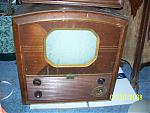
Tube Co. in Des Moines, IA to have another go at rebuilding 15GP22s. Bob and I each brought an under vacuum dud tube, and a known leaker tube. The plan was to rebuild the two tubes that were under vacuum, and have Scotty install dummy guns and stems on the two leakers, so we could take them to a Michigan University lab for leak testing. We had with us some of the redesigned Richland stems used successfully to rebuild the first 15GP22, and several rebuilt 15GP22 gun assemblies mounted on the new style Richland stems. Scotty first installed the dummy guns and stems onto the two leaker tubes without incident. Next he installed rebuilt 15GP22 guns onto the two under vacuum 15GP22s. One of the two stems that were mounted to the under vacuum tubes, cracked while the tube was cooling down. We had extra guns, and the second attempt was successful. The two "non-leaker" tubes went into the oven and began the baking and evacuation cycle. (first photo) Bob's tube had aluminum filled high temperature epoxy applied to the glass to metal joints around the flange of the tube. My tube had vacseal applied to the same areas. Within a couple of hours, the mechanical backer vacuum pump was making gurgling noises. (this sound from the pump is a sign that a tube is leaking) The pump for Bob's tube was turned off. Bob and I went to the motel room for the evening. In the morning, Scotty informed us that my tube had also failed in the oven, during the tip-off cycle. Tip off is is where a electric heating element heats the glass exhaust stem and causes it to melt and collapse, sealing the tube shut. Opening the now cool oven door revealed the following damages. Bob's tube had failed because the epoxy material's difference in temperature coefficient of expansion, had pulled up flakes of glass from the surface, which propogated a crack around the face of the CRT, at the glass to metal joint. A whack with a rubber mallet separated the faceplate from the front of the CRT. My CRT had failed due to a crack in the stem. And in addition, there was a crack in the phosphor dot plate. So this leaves both of these tubes destroyed. Later that week Bob and I took the 2 leaker CRTs and a curing oven to a Michigan University lab where leak testing was performed using a helium leak detector. This equipment consists of a mechanical vacuum pump and a turbo-vacuum pump, which can evacuate the CRT rapidly, and a mass spectrometer that looks for the presence of helium in the exhaust from the CRT.(second photo) Leak checks on Bob's tube revealed two closely spaced leaks at the edge weld where the 2 metal flange pieces were heli-arc welded together. Leak checks on my tube revealed leaks at the glass to metal seams. Bob attempted to seal the leak in his tube by apply a non- filled version of the high temperature epoxy, but it was not possible to keep the epoxy in place on the leaks where we wanted it, and so the attempt to seal these weld leaks failed. We put vacseal on the glass to metal joints on my tube, and within the limits of the equipment, it appeares that the leaks have been sealed. We had also brought with us, a 21AXP22 CRT which Scotty had previously rebuilt for me, which had leaked after removal from Scotty's oven. Leak checks on this tube revealed a leak at the flange weld line on this tube. These leaks in the welds on the CRTs was unexpected, and adds a new level of complexity to our problems. Bob and I returned to our respective homes, and the three leaker CRTs stayed with Bob. He began some experiments on a flange from a broken 15GP22 to see if he could braze the flange weld. Preliminary results are encouraging. Today I was troubleshooting a strange and difficult to isolate high voltage arcing problem with my Motorola 15" color set. I decided to use the only successfully rebuilt 15GP22 from our attempt back in November of 2009, to determine if the problem was with the Motorola CRT or mounting fixture. Both the Motorola CRT and the rebuilt 15GP22, are mounted on slide-in wooden CRT holders, so it was easy to simply swap CRTs on their holders, and put the Motorola yoke on the rebuilt CRT. Upon power up, there was no raster. A few quick checks revealed a dreadful purple glow in the neck of the rebuilt 15GP22! Argggggh! The tube has sprung a leak.(third photo) Discussing this with Bob, and considering everything we have done to date, and the fact that we still have unresolved stem cracking issues, we agree that we can no longer justify the expense of additional attempts to rebuild tubes. Maybe in the future, if CRT rebuilding can be set up at the ETF museum, and the overhead cost of rebuild attempts becomes much lower, we may consider continuing the effort. But for now at least, I think we have done all that we can justify doing. John and Bob
__________________
John Folsom 
|
|
#2
03-12-2010, 09:01 PM
|
||||
|
||||
|
I'm very sorry to hear this John. Your results last fall seemed so encouraging. Perhaps if rebuilding at Steve's becomes a reality this will help, but it sounds like there are still some issues to solve
 Darryl
|
|
#3
03-12-2010, 09:11 PM
|
||||
|
||||
|
John, Bob,
Reading this at 04:00 AM in Paris and feeling depressed. Even though i've known this info since 48 hours, i feel that the "big silence/zero reply" from the TV collector community is not a good show of support for two TV collectors/engineers/afficianados who went WAY beyond & all stops removed to get those darn 15Gs to work again. Come on guys! let's have a round of applause and Kudos for John and Bob for all their efforts over the last 5-6 years to get 15Gs rebuilt. What they have done is not in vain, and even though the announced closing of Hawkeye is a serious blow, the knowledge gained lives on and will be applied successfully at the future ETF rebuild site or elsewhere. The ETF meeting takes place next month, why not have John and Bob as guests of honor of a diner at this get-together. I, for one, will gladly contribute to this project (Steve; practicalities?) Come on Gentlemen! let's show some support and honor properly these two outstanding members of our close-knit early TV community. Best Regards jhalphen Paris/France
|
|
#4
03-12-2010, 10:11 PM
|
||||
|
||||
|
Darryl, thanks. Jerome, not sure what the 48 hours refers to, I just discovered the the leaking rebuilt 15GP22 this afternoon. Sad news, but not entirely unexpected. This whole effort has always been a ling shot, and it has been, and still is, a grand adventure. No regrets! Thanks for your support, and maybe RACS will come through! :-)
__________________
John Folsom
|
|
#5
03-12-2010, 10:12 PM
|
||||
|
||||
|
that's a shame! It's too bad that the Chinese or Russians couldn't run out a supply of 15g clone crt's, I know it wouldn't be the same but at least the sets would still continue to operate.
__________________
[IMG]
|
| Audiokarma |
|
#6
03-12-2010, 10:30 PM
|
||||
|
||||
|
I always tell myself 'If it was easy, anyone could do it'. I have followed this and realize that funds will certainly stall efforts to proceed. I ask, how can this community aid in keeping this going forward?
|
|
#7
03-12-2010, 10:35 PM
|
||||
|
||||
|
John,
That is indeed very sad news after all of the effort that has been put into the project. That picture of the purple glowing gun brought back the memory of one of the worst experiences that I have had related to this hobby, I can't even begin to imagine how you must have felt. I am at a loss for words ! jr
|
|
#8
03-12-2010, 10:38 PM
|
||||
|
||||
|
Your problem is that you didn't have me there in my capacity as a Professional Worrier. I coulda stood there, wrung my hands, rolled my eyes, looked sad, went "Omigawd !, Oh, Lordy !" trembled the coffe cup in my hand....Seriously, wish there was somethin' I could do...I'll NEVER have a set that uses one of these tubes, never even SEEN one, but that ain't the point..
__________________
Benevolent Despot
|
|
#9
03-13-2010, 02:07 AM
|
||||
|
||||
|
Just saw this new thread on the efforts - Bob and John, definitely sincere thanks for taking this on with all the unknowns. Guess I should see about getting my first leaky 21AX back from Scotty some time before he shuts down. I now have two, so if there is any hope in the future for the bigger tubes, I have duds to contribute, one probably a fast leaker and the other probably a slower one.
|
|
#11
03-13-2010, 09:39 AM
|
||||
|
||||
|
Not the best news, but not the worst either. At least we know what will not work. Remember, Edison had over 1500 failures before his "LIGHT" worked. - Bob and John, you did good, you deserve a rouund of applause and a hearty thanks for trying.
__________________
RCA VICTOR and its dealers bring you......
|
|
#12
03-13-2010, 09:44 AM
|
|||
|
|||
|
I feel a need to add to the “eulogy” for the 15Geez. It was always a high mountain for our fearless comrades to climb. But as John Folsom said, it was a grand adventure – and our lives require adventure. In many ways, “adventure” – along with avoiding starvation, etc., defines our human lives. An adventure is something we take on with no guarantees. Above, I used past tense, but I’m not without optimism that they or others will eventually succeed. Who can say how they might eventually build on their new understanding and find the key(s) that leads to total victory over the complex challenge our 15G guys confronted?
May I digress a wee bit? I guess I’m one of the few who ever saw a color picture on a 15G set, back when they were still “new.” It was on our 15G Admiral and I’m reminded how tricky it was to get a decent picture – in Wichita, Kansas, over-the-air. At that time, about 1957, those sets were already obsolete and we bought ours for $65. The seller had won it in a contest and had less than zero interest in keeping it. (Few 15G’s were ever sold and I’ve always wondered how many of those Admirals were ever manufactured – let alone, sold.) But I was just young enough and naive enough to believe that I could impress the neighbors with COLOR TV. It was primitive but it was fun. Not easy to watch a world series on that little screen. I was always trying to tweak the convergence and purity – with no instrumentation to assist. The only repair I remember was ordering a replacement focus control; the original couldn’t hold up to the load on it. Eventually my teenage interests moved on and I don’t even remember the final disposition of that set. I probably used the proceeds to “fix up” my first car. Just now, my memory clicked onto the 19” Motorola that my brother and I also cadged along the way to my first 21” color set – a 1958, or so, Sylvania – with its unique ratcheting tuner lever. It was probably a $500 floor model that had set around for too long – I think we paid $100. Allow me to digress even further. Yesterday, we went to a Best Buy store to see a Samsung 3-D LCD model set up for demonstration. It actually brought back a memory from 1954, of our dad taking us downtown to see a COLOR TV (Westinghouse) set up in the window of a department store – probably the only color TV in Wichita – other than a broadcast monitor back at the transmitter. We were part of a small crowd straining to see the washed out picture (summertime, about 7PM) of Ed Sullivan’s Toast of the Town show from the local CBS affiliate, KTVH. If that was color TV then that demo would never sell any. Neither would yesterday’s demo at Best Buy. Three sales people fumbling around that Samsung – three who seemed totally incapable of demonstrating 3-D or understanding any of the physics that made it possible. When they handed us cardboard glasses with blue and red cellophane lenses, I knew that we had a serious problem and would not likely be seeing any 3-D TV that day. Later, one of them told me that the (necessary) Samsung viewing glasses hadn’t arrived yet. Better luck next time to the Best Buy people. And, better luck and future success to all those motivated and talented people who contributed to the 15Geez effort. Roger Dreyfoos
|
|
#13
03-13-2010, 10:01 AM
|
||||
|
||||
|
We all owe John and Bob our thanks for the many hours (and dollars) they spent on this project. Though the results were disappointing, we can hope that what they learned will pave the way for success in the future.
Guys like this are what keep our hobby going, and keep the history of early television alive.
|
|
#14
03-13-2010, 10:29 AM
|
||||
|
||||
|
Much thanks to everyone, for your kind words of support. As many of you have said, we have indeed learned a lot in our quest to rebuild the 15G. And what John and I have learned will serve as a foundation for the effort going forward.
Everything we have learned and done will be presented at the upcomming ETF convention in our presentation on Saturday afternoon. Hope to see all of you there. Bob and John
__________________
Vacuum tubes are used in Wisconsin to help heat your house. New Web Site under developement ME http://AntiqueTvGuy.com
|
|
#15
03-13-2010, 10:55 AM
|
||||
|
||||
|
Ouch, that is disappointing. You guys have gone the extra mile in this enterprise, and everyone owes you a hearty vote of thanks. We can only hope there is a solution to be found in the future . . . .
Phil Nelson
|
| Audiokarma |
 |
|
|











 Linear Mode

