
|
|
|
#1
 08-26-2014, 10:44 PM
|
||||
|
||||
|
Any thoughts?
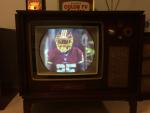
Anyone have a clue as to what might be causing this condition on my Admiral Telebar? Set has had this condition since restore.
If you look at the attached photo, you can see the picture is much brighter in the center. So if you divide the picture into thirds vertically, the center third is brighter than the edge thirds. Adjusting the brightness and contrast sees the condition stay the same. Center is always brighter no matter how bright the picture is. Anyone seen this before?
__________________
-Al 
|
|
#2
08-26-2014, 10:46 PM
|
||||
|
||||
|
Can see it better here with brightness turned down a bit. Sides very dark, center brighter.
__________________
-Al
|
|
#3
08-26-2014, 11:32 PM
|
||||
|
||||
|
Possibly the horizontal is drawing enough power off an under filtered power supply to have it leak into the video circuits and modulate them. That could be tested by putting large capacity lytics in parallel with the filters and seeing if that cures it.
__________________
Tom C. Zenith: The quality stays in EVEN after the name falls off! What I want. --> http://www.videokarma.org/showpost.p...62&postcount=4
|
|
#4
08-27-2014, 01:32 AM
|
||||
|
||||
|
Just a wild guess, but maybe the aluminization of the CRT is non uniform? Could find out by testing with a different CRT.
|
|
#5
08-27-2014, 06:55 AM
|
||||
|
||||
|
Quote:
90 degrees. Next step is to look at waveforms of a horizontal bar pattern with a scope.
|
| Audiokarma |
|
#6
08-27-2014, 09:36 AM
|
|||
|
|||
|
Any chance you could post the schematic of the video out. and horz out areas?
Your older pic of the set running (presumably before the resto) didn't show the problem.
|
|
#7
08-27-2014, 12:02 PM
|
||||
|
||||
|
Quote:
Is the set the one you mentioned in this thread: http://www.videokarma.org/showthread.php?t=261516 If so, there is no bright spot in you test pattern in the first post. Was this taken prior to recapping? (There is a complete schematic of that set posted in the thread.) Also, there seems to be some unwanted ringing on the flyback in your Youtube link in the final post, and that could have been an precursor to what we see now. If you use that test pattern, or better yet a crosshatch pattern from a color bar generator, you will quickly be able to tell if your problem is from speed modulation of the horizontal sweep or video being contaminated by an as yet undetermined source. To see if there is an uneven coating on the CRT (unlikely, as your first picture in the above mentioned thread does not show this problem) is to intentionally throw the horizontal out of sync and see if the extra brightness in the center remains. (If it remains, suspect CRT.) Double check the values including the multiplier on the capacitors across both the horizontal lock coil and horiz linearity coil. It looks like one of these might accidentally be trying to ring at double frequency and the sync circuit is preventing it. (Rare, but it can happen.) Also, do the electrolytics jumping tests in the power supply test that Electronic M suggests. Also, the 10MFd across the horiz output cathode. James. Last edited by earlyfilm; 08-27-2014 at 12:18 PM. Reason: clicked send, when I intended to hit preview
|
|
#9
08-27-2014, 01:44 PM
|
|||
|
|||
|
Quote:
It wouldn't matter whether the horz is synched to the station or not.
|
|
#10
08-27-2014, 07:14 PM
|
||||
|
||||
|
Wow! That's a ton to digest!

__________________
-Al
|
| Audiokarma |
|
#11
08-27-2014, 09:37 PM
|
||||
|
||||
|
Quote:
Either you narrow down the search area, or you check every component that you replaced, then every tube and component that you didn't replace.  I think that you'll decide that to it is much easier to narrow down your search area with a few simple tests. I think that you'll decide that to it is much easier to narrow down your search area with a few simple tests.After a recap, always take a bright light and a magnifying glass and check all freshly soldered connections for cold joints. Gently wiggle the wires and see is something moves that should not. Observe how the solder flowed. It should flow outward, not inward on the connecting wires, if correctly done. In my first post, I should have mentioned the obvious: First substitute the damper and horizontal output tube. Without any tests, my best guess by probability is: 1) Damper tube. 2) Miswired or mis-adjusted Horiaontal linearity coil. (Check those three caps for value) (Same for Horizontal Lock coil, & cap, just in case) 3) Too much horizontal drive (trimmer too tight) and mis-adjusted width coil to compensate. 4) A combination of 2) and 3). 5) Wrong value, wrongly connected or omitted capacitor. Big Al, refresh my memory. Do you have a 'scope? If so, the first thing to do is to check to see if the waveform on the grid of 6BQ6 matches slight hump in the sweep as shown on the diagram. Quote:
>>> If the extra brightness remained in the center, it would indicate either defective CRT or Damper circuit and/or B-Boost issues. The latter two are more probable, as there was horizontal ringing showing up youtube video in the final post on the other thread. It is also possible that Bob overcorrected while adjusting the horizontal drive and/or horizontal linearity and/or width. >>> If the brightness in center disappeared (it would have moved to the diagonal lines where it would be almost impossible to see), that would indicate CRT was OK and the damper was probably working correctly and sweep was relatively linear. Note: One also could have done this test by tuning a unused channel, but doing so could complicate the test by accidentally introducing symptoms that are unrelated to the present problem. James
|
|
#12
08-27-2014, 10:45 PM
|
||||
|
||||
|
Scan nonlinearity is often the culprit for brightness variations, but when scan nonlinearity is the cause, usually you can see the nonlinearity of the scan directly, as well as the change in brightness that goes with it. When there is horizontal ringing, for example, you can usually see "wrinkles" in the picture along with the brightness variation. The wrinkles, of course, are only visible if there is content in the image that lends itself to recognizing it, like lettering, some kind of grid-like image, etc.
Looking at the second picture you posted, which has lots of nice lettering all across the screen, I don't think I can see any evidence that the lettering in the bright area is compressed horizontally compared to the darker area. So it looks to me like scan nonlinearity isn't the cause in this case.
|
 |
|
|




 Linear Mode

