
|
|
|
#1
 12-26-2006, 09:24 PM
|
||||
|
||||
|
Zenith X334
My latest project:
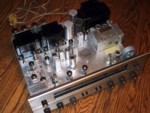
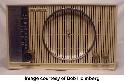
 This was a mess out of the box; trashed and broken. After tearing it apart, cleaning and fixing the totally bent and screwed up dial face, I checked the caps for leakage and fired it up. To me, the X334 sounds more like the K731 than the C/G730, but isn't as pretty as any of those. Still, it's a nice radio with a smooth, bassy tone and decent highs. It looks to have a larger, more ovaled speaker than what's mounted on the C705 chassis, but the tweeter is standard issue Zenith. The chassis cleaned up nicely:  It's no 845 for sound or reception, but a very decent listener. I'm out of new caps to finish it, but want to find out what I need for my EMUD before I place another order. The dial lamp takes one 1819; which are getting hard to find around here. I hate the flimsy, paper backed tin around the tuning face (you might notice one spot where I rubbed a bit too hard) but I did try out my new process of knob refinishing. I haven't perfected the shiny brass look yet, but the paint and clear application at least makes the radio presentable. In all, the X334 is a nice radio...a better unit than I gave it credit for. 

|
|
#2
12-26-2006, 11:50 PM
|
||||
|
||||
|
I have a couple from this same era, most with the chrome worn off the knobs. What's your technique?
__________________
I may be growing older, but I refuse to grow up. 
|
|
#3
12-27-2006, 03:09 PM
|
||||
|
||||
|
Not much to it really. I pull the knobs and soak them in Simple Green (to wash away the old grime from dirty fingers, etc...yuck) then rinse and wipe.
That usually takes care of the rest of the plating. :-) After that, most are stripped to pure white plastic. I found some modeling paint at Crafts Mart that looked like a gold/chrome finish (according to the cap) but it is more of a satin metallic. I use three coats of flat black primer, two or three coats of the gold (allowing to dry in between) then two or three coats of 'truck and auto' detailing clear to finish. It looks pretty good, considering it's from a bomb can, and hopefully the clear will lend a bit of extra durability. Paint the knobs face down to protect the inside lettering and color, plus the leading edge finish which isn’t usually worn away. 
|
|
#4
12-27-2006, 04:33 PM
|
||||
|
||||
|
Thanks for the reply. I'll see if I can find some shiny brass color and clearcoat.
__________________
I may be growing older, but I refuse to grow up.
|
|
#5
12-31-2006, 03:50 PM
|
||||
|
||||
|
RE: Zenith X-334
Saw your post and pics, nice job! I was checking out this section because I have a friend who collects old radios.
I recognized your radio as resembling the one I listen to when I'm working on my car in the garage! When my aunt passed away in the '70s, my mom was in charge of handling her estate. My mom had told me, "if there is anything you like, take it". For some reason, I wanted that old radio. Don't ask me why. It works great, after the tubes warm up. In the picture, I have a small piece of masking tape near the volume knob on the radio...my visual preset of the volume I usually listen to. Mine looks a little different than yours. It's an X334W, dated 1-30-59? (See picture of tag) It looks like the legs are different, the wood is darker, and the grill cloth is dark also...the rest looks like the same set-up. I know nothing about this radio. You inspired me to clean it up! The volume knob comes off really easy, but the tone knob does not and I'm afraid of breaking it. Does the tone knob slide out like the volume knob? I might try painting the knobs.
|
| Audiokarma |
|
#6
12-31-2006, 06:35 PM
|
||||
|
||||
|
The knobs are usually designed so they cannot come off...there is a guard on the inside of the cabinet on the knob shank. The chassis of the radio connects directly to the powerline and the guards are to prevent electrical shock from coming in contact with "hot" control shafts or the chassis. The knobs can be loosened but I don't think they can be removed. During disassembly of the set the chassis must be pulled away from the knobs rather than the usual process of pulling the knobs off.
Last edited by Chad Hauris; 12-31-2006 at 06:42 PM.
|
|
#8
12-31-2006, 07:56 PM
|
||||
|
||||
|
First of all, I wonder if Zenith's system of letters behind the model number depicts finish. For example, every blonde C730 I've seen is labeled an 'E'. My X334 has no letter designation, so I'm not sure if my theory is right or not.
The knobs are fastened to the shafts by a round metal clip that fits over the knob’s plastic shaft. Ideally, the knob should slide off (with some pressure) but the fact that your volume knob is missing its clip means somebody's probably had the chassis out at some point; not hard to imagine and no big deal. If you don't move the radio around much the knob should stay put, but be careful; when your Zenith is plugged in the chassis has ac current running through it, so make sure it is unplugged before you work on it. Zenith also displayed the habit of placing the same radio chassis is different cabinets. Like the popular K731, the X334 was available in Colonial (like mine) or Early American, with little legs. Both are very handsome styles, and allowed the buyer to pick a radio that matched their home decor. Finally, I think we all are drawn to antique or vintage radio for various, but similar reasons...a certain attraction that isn't easy to describe. For me, it's a nostalgic hobby that I can enjoy at home, while spending time with my family. It is also very affordable. Zeniths are desirable because they perform very well and because there is a lot of them out there, so enjoy yours!
|
|
#9
12-31-2006, 09:43 PM
|
||||
|
||||
|
Quote:
As to the knob with a missing clip: A paper shim between it and the volume pot shaft should keep the knob from sliding off. I second the warning on unplugging this radio (or any other AC/DC set with a hot chassis, for that matter) before starting any repair or maintenance work on it. While a hot-chassis radio, TV or stereo unit (anything with a hot chassis) is in fact grounded through the AC line when the line plug is in the socket a certain way, there is a 50/50 chance that the plug will be inserted in such a way that the hot side of the line is connected to the chassis; in other words, there's as much of a chance of getting it wrong as getting it right, since there is no way of knowing which side of the line is connected to the set's chassis and metal parts unless you use a light-bulb test jig to determine which side of the outlet is ground before starting the job. So I'd unplug the set before working on it, as Nolan suggests. This gives you 100 percent assurance that the chassis is electrically cold and absolutely safe to work on. It is always better to be safe than sorry.
__________________
Jeff, WB8NHV Collecting, restoring and enjoying vintage Zenith radios since 2002 Zenith. Gone, but not forgotten.
|
|
#10
12-31-2006, 10:08 PM
|
||||
|
||||
|
All of the Zenith sets("AC/DC" and some sets which use a plate voltage transformer and still have series filaments) which contain an interlock on the power cord have one side of the power line connected to the chassis. I would not recommend powering up these chassis outside the cabinet unless an isolation transformer is used, You can potentially get shocked from the neutral of the powerline as sometimes it will carry current.
On the earlier Zenith models which have the interlock female end attached to the back cover I have replaced the old cord with a polarized power cord with the neutral connected to the prong going to the chassis. Last edited by Chad Hauris; 12-31-2006 at 10:11 PM.
|
| Audiokarma |
|
#11
01-02-2007, 09:02 PM
|
||||
|
||||
|
Nolan, Chad, and Jeff thank you for all the information
I know a lot more, than I knew before, about my old radio! The warning about the chassis is very handy, since I do tend to mess with things if they stop working...fortunately the radio has been working fine ever since I obtained it and I just listen to it...
It's funny I was wondering about the "W" if it meant Walnut finish and Nolan was thinking along the same lines. I take it you all listen to your radios and don't just collect them to look at? I have a friend who collects vintage radios because he thinks they look cool, but he says a lot of them don't work. I'll let him know about this site, maybe with the information here he can get some of those cool looking radios to work! I think I was drawn to my old Zenith because it was made of real wood and it had a full sound with tone control! There is a little suspense when you turn one on too...as the tubes are warming up I often wonder is it still working? Ah yes, it still works! -Jon
|
|
#12
01-02-2007, 10:42 PM
|
||||
|
||||
|
very nice Nolan. Thanks for the restoration tips!
|
|
#13
01-02-2007, 11:05 PM
|
||||
|
||||
|
Thanks Steve! Say, did you ever get around to dialing in that K731?
This X334 actually looks better in person than it does in the pics. I had hosed down the grill cloth and blotches were still drying when I took them. The Canon 20D digital I use for my magazine work is a bit harsh for tatty old radio photos. I'd be better off shooting this stuff with a warmer vintage triplet, then getting the slides digitized. But at nearly $30.00 a piece... For normal dirt on old grill cloths, Simple Green does a nice job of lifting it off without adding more stains. I spray it on (with the chassis and speakers removed) then dry it by blowing a light stream of compressed air through. Usually, the cloth comes back brighter and much cleaner looking, but I've shredded a couple doing this too. By all means Jon, tell your friends about AK's Antique Radio. The guys that hang out here are some of the best, bar none.
|
 |
|
|





 Linear Mode

