
|
|
|
#256
 07-07-2011, 03:33 PM
|
||||
|
||||
|
Quote:

|
|
#257
07-07-2011, 04:54 PM
|
|||
|
|||
|
Xray emission from the rectifier happens only during electron bombardment of the plate, which occurs only during the positive-going half cycle, and the max voltage is half the PIV value. The only real concern over Xrays was in color sets where 25KV on the pic tube anode was typical, and that hype was hugely overblown (IMHO). Heck, if Xrays were any danger i oughta have been thoroughly cooked many years ago.

|
|
#258
07-07-2011, 04:57 PM
|
||||
|
||||
|
I actually have a SS stick rectifier that I found in a box of tubes that I got for cheap in a swap meet donation auction. Not sure what to do with it, but will probably keep it as a diagnostic tool/spare for sets with open HV fill windings.
Tom C.
|
|
#259
07-07-2011, 10:14 PM
|
||||
|
||||
|
Quote:
Does your probe have its own meter or does it plug in to your multi-meter? old_coot88 is right about x-ray production only occurring during the positive going half cycle which causes electrons to bombard the plate. However, they don't even have half the PIV. The forward drop on these tubes is between 80-200 volts. The electrons only get accelerated to that energy. Those x-rays will never make it out of the 1X2. If there was a failure of the 1X2 such that the forward drop was as high as half the PIV, then you'd have higher energy x-rays, but the cathode emission would be so low at this point that the x-ray dose rate would be very small because of the very low current.
|
|
#260
07-08-2011, 06:02 AM
|
||||
|
||||
|
Quote:
Thanks for the reassuring words on X-ray emissions. It kind of got me nervous when the last 1X2 I picked up had a warning painted right on the side of it about X-Rays.
|
| Audiokarma |
|
#261
07-08-2011, 10:10 AM
|
|||
|
|||
|
Quote:
|
|
#262
07-08-2011, 11:07 AM
|
||||
|
||||
|
Quote:
I remember the CTC-11's service switch well, and that's one reason why I've become eager to clean everything early. After recapping, the set worked very well except for one weird symptom. It was magically cured when Bill asked whether I had cleaned the service switch! Phil Nelson
|
|
#263
07-08-2011, 12:50 PM
|
||||
|
||||
|
Quote:
|
|
#264
07-10-2011, 05:11 PM
|
||||
|
||||
|
Did a good cleaning of all of the tubes today. I also did a good scrubbing of the tuner. I tried moving the horizontal hold in both directions to the maximum. I also changed the channel on the tuner. All of which provided no video. The brightness control works and if I turn it up to maximum I have enough output to see through a phone book I think, the contrast has a very very minimum effect. I was wondering and wanted to ask all of you here is there some test I can run to verify the tuner itself is working versus the if stage not working? Another step I took while working on the underside of the set was to clean up some of my previous work. I decided that I would not accept the level of work I did on this set on future sets so why not start having that work ethic now.
Before: 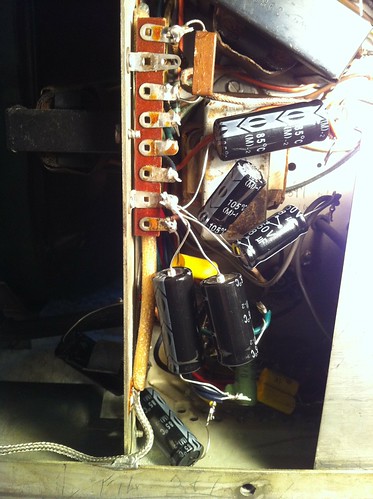 After:  One other note, I hooked up the speaker to the set and I am also not getting sound output. I do get a very low hum that increases with the set brightness. Can some one tell me what the term for this is called?
|
|
#265
07-10-2011, 05:40 PM
|
|||
|
|||
|
Well first off, does your version of the set have the 'color' switch? If so, what happens when you click the switch back and forth? And does yours have the TV-phono switch? If so, what happens with the sound if you click this switch between TV/phono?
On the hum thingy with brightness, try turning the vert. hold from stop to stop. Does the hum change frequency ('pitch') or remain constant? If it remains constant, this tells you it's not vert. sweep bleed-through. oc
|
| Audiokarma |
|
#266
07-10-2011, 06:03 PM
|
||||
|
||||
|
Quote:
|
|
#267
07-10-2011, 06:30 PM
|
|||
|
|||
|
Hokay, how about checking the video detector diode (M4). While you got one end clipped loose, turn the set on and with a clip lead, intermittently short the grid of the 12AU7 1st video stage (V6) pin 2 to ground. Try this with the contrast control at both ends of its rotation. If the two video amp stages are working, there should be some very robust flashing of the raster.
|
|
#268
07-10-2011, 08:14 PM
|
|||
|
|||
|
Do what OC suggested first... If a no go, Then you may not be getting b+ voltage to the tuner or the IF circuits. Check and see if the B+ is going into the tuner first and then check for correct voltage at the IF tubes. Look for open resistors in the power supply and the tuner / IF circuits... Be careful!!! The B+ power supply voltage is more dangerous than the high voltage due to the higher current in the B+ power supply.
|
|
#269
07-10-2011, 10:44 PM
|
||||
|
||||
|
That's what I've been thinking too - B+ isn't getting to part of the set. Less current draw would account for excessive voltage in the parts that are getting power.
|
|
#270
07-11-2011, 07:04 AM
|
|||
|
|||
|
Y'know, the term "B plus" might be a little esoteric to a total Noob unless some background wuz provided on how the term came to be. Looks like he's hopelessly addicted to vintage TVs
 , and the term is gonna be ubiquitous to the addiction. , and the term is gonna be ubiquitous to the addiction. Anyhow, it harks back to the early days of radio, when radios ran on batteries. The tube filaments ran off a low voltage battery called the 'A' battery. The plates were supplied by a higher voltage source of 90V or more, called the 'B' battery. As radios evolved to run on house current, the plate source continued to be called the 'B' supply, and since it was of positive polarity, simply "B+". And the convention carried on into television practice.
|
| Audiokarma |
 |
|
|


 Linear Mode

