
|
|
|
#1
 08-03-2014, 06:02 PM
|
|||
|
|||
|
Back Cover For My RCA Victor
I refinished an RCA Victor VR-60 that my mother bought in 1941...
 Gregb, a member here, did the electrical for me. Anyway, the back cover is long gone. I have vague recollections of it but the memory is foggy. I realize I'm going to have to make my own, but can anybody tell me what the material used for that model and vintage of RCA was? 
|
|
#2
08-03-2014, 09:23 PM
|
||||
|
||||
|
I think by that time, a product commonly known as "masonite" was used. It is a sheet of medium density fiberboard with holes punched in it. Some manufacturers claimed better sound by using a back cover. I have a 1938 RCA U128 that has screw holes for back cover as well.
By the way, that is a nice RCA Victor. What features on record changer is in it? At that pre-war time Philco was advertising the beam of light pickup instead of the replaceable needle..
__________________
"When resistors increase in value, they're worthless" -Dave G
|
|
#3
08-03-2014, 10:28 PM
|
|||
|
|||
|
Thanks, DavGoodlin!
Unfortunately the original record player (an automatic 78) disappeared about the same time as the back cover, sometime in the early 1960's, and was replaced by a Moose (that's the brand name) turntable. I've left it out and use the RCA jack as an input for an iPod. I just remember it was an automatic changer and made a cool frrrrppp sound when I ran my finger across the needle. Used to irk my dear old Mom... 
|
|
#4
08-03-2014, 10:47 PM
|
||||
|
||||
|
Quote:
'Yo Mama... Made a very good purchase back in 1941.  Masonite is still available, you're looking for something that on one side looks like a traditional clipboard board, and on the other it will have an unifinished surface with texture like a window-screen. You can find it with either both sides smooth or both sides unfinished, but normally its just one side. Also commonly used as the material of drawer-bottoms for cheaper furniture, but it looks like you need at LEAST 1/2 of a 4x8 sheet for that very attractive piece of cabinetry, possibly more so I don't think you can harvest yours from a dresser...
|
|
#5
08-03-2014, 11:46 PM
|
|||
|
|||
|
Thx, NoPegs! Yes, my Mama was proud of her radio.
 It has special significance for me. Two of the most vivid memories of it are hearing The Beatles for the first time, and coming home and seeing my mother sitting in front of it weeping over the news of the death of President Kennedy. The SW exposed me to foreign radio stations and made me want to visit those places. Quote:
Hardboard It's close to what I think I remember... So I guess I'm on the right track.
|
| Audiokarma |
|
#6
08-04-2014, 09:20 AM
|
|||
|
|||
|
Quote:
They still make the stuff. The back covers from the Sauder assemble-it-yourself furniture, still uses it. 
|
|
#7
08-04-2014, 09:40 AM
|
|||
|
|||
|
Quote:
|
|
#8
08-04-2014, 02:55 PM
|
|||
|
|||
|
Quote:
I'll need to look into this a bit more. Quote:
Thanks, DJ
|
|
#9
08-06-2014, 07:36 PM
|
||||
|
||||
|
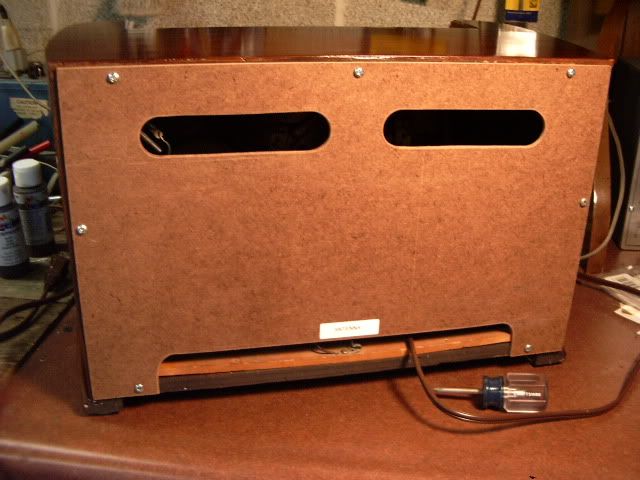
You can get Masonite in 1/8" and 1/16" thickness. The thinner stuff would be fine for a back. The trouble is getting a pattern of slots and holes to look good and even. Takes some careful layout and cutting. The easiest for tube cooling is a slot across the top and one across the bottom of the chassis area, allowing for air in, air out. Here's an example of one I did in the thin Masonite for a table set.
__________________
Reece Perfection is hard to reach with a screwdriver.
|
|
#10
08-07-2014, 09:00 AM
|
||||
|
||||
|
Quote:
What's the trick for making the edges on the cutouts look so damned nice? Just a very high speed router bit to give that smooth factory-like edge? In my head I had just sort of always thought that the originals were made on a punch/press/die-cutter type thing, and that trying to replicate that in the home workshop was difficult. Obviously if you know a guy who has access to a water-jet table it comes out better than attempting it with a jigsaw or cope or even a dremel, but the idea of a router had not occurred to me.
|
| Audiokarma |
|
#11
08-07-2014, 05:29 PM
|
|||
|
|||
|
Well, for the interim I got some 1/8 foam core board. I think it does make the radio sound better. While the radio was playing I touched the back and could feel it vibrating like a speaker cone.
 I still have to cut out a couple of vents for the receiver compartment. That's only about 12X12 inches and the rest is just open cabinet space, so thankfully i won't have to do too many cuts to get adequate airflow.
|
|
#12
08-07-2014, 07:51 PM
|
||||
|
||||
|
Wish I had a router but I made my cuts using a hole saw in a drill press to make the two ends of the slot, and then clamping a guide to the back and cutting between the holes with a saber saw.
__________________
Reece Perfection is hard to reach with a screwdriver.
|
|
#13
10-06-2014, 12:08 PM
|
|||
|
|||
|
Quote:
|
 |
|
|


 Linear Mode

