
|
|
|
#1
 02-20-2016, 07:54 PM
|
||||
|
||||
|
Reducing RFI off the powerline into radio set
Too another angle in getting better reception of weak AM radio stations. This one is to restrict RFI riding on the powerline from getting into the radio. Took an EMI filter network from an old computer monitor, like this below:
and placed it between the radio's power cord and the powerline input of the radio circuits. You can tell if this is a reasonable thing to do by this test: While listening to a weak station with powerline RFI buzzs, disconnect the power plug and quickly listen to see if the buzz goes away before the station and the radio dies. We're talking about 1/4 second, before the mail filter caps in the radio's power supply looses charge. You can repeat this test after installing this filter and see if any buzz left over still stays on the station after pulling the plug. Idea is that you effectively pulled the plug on the path the RFI was taking. That your plug in radio acts like a portable on batteries.
__________________


|
|
#2
02-22-2016, 06:30 PM
|
||||
|
||||
|
Would this work to reduced lamp dimmer interference? This is outside of my wheelhouse of knowledge. This sounds like a nice little wall-wart sized module project.
__________________
“Once you eliminate the impossible...whatever remains, no matter how improbable, must be the truth." Sherlock Holmes.
|
|
#3
02-22-2016, 06:58 PM
|
||||
|
||||
|
Would be advisable to use type X2 "across the line interference suppression caps" for the capacitors in this circuit. They stand up better and are less likely to fail than standard caps.
__________________
Reece Perfection is hard to reach with a screwdriver.
|
|
#4
02-23-2016, 12:22 AM
|
||||
|
||||
|
Many newer TV's/monitors (80's and newer) have this or a similar network...It's easier to just cut off the section of a junk set's PCB that contains this network add some power connectors and throw it in a box than make one from scratch....I have a couple such networks laying around if needed.
I'm surprised collectors keep sources of RFI like CFLs and certain types of dimmer switches around. There is not one CFL in use here, and if we used dimmers I'd see to it that they are not RFI sources.
__________________
Tom C. Zenith: The quality stays in EVEN after the name falls off! What I want. --> http://www.videokarma.org/showpost.p...62&postcount=4
|
|
#5
02-23-2016, 12:55 PM
|
||||
|
||||
|
Quote:
 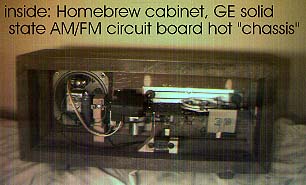 These pictures don't show this addition, but if you look closely enough, there is room for a board behind the speaker. I also moved the power cord cheater cord socket away from the AM ferrite rod antenna. There's a masonite back cover you don't see here as well. Better pictures: This mod almost makes it seem like the early 70's on the AM band, before switching power supplies existed.
__________________
Last edited by wa2ise; 02-23-2016 at 02:55 PM.
|
| Audiokarma |
|
#6
03-01-2016, 11:23 AM
|
|||
|
|||
|
Is the large WW resistor, a voltage drop for the radio? If so, what value is it.
My older GE Superadio picks up a lot of interference from the neighbors, even when I'm using it on batteries, but much worse on AC. It seems like The building next to me has some kind of a motion detector alarm system, that emits an RF pulse. I don't think, I can clean that up. 
|
|
#7
03-01-2016, 12:18 PM
|
||||
|
||||
|
"From an old computer monitor"
What else has this network built in, would a PC power supply? Don't have any PC monitors sitting around to cannibilize but plenty of other junk. I definitely have noticed that line powered radios have much worse buzz than transformer operated radios. Some of my AA5s are almost Unusable these days. EDIT To answer my own question, I looked at things like this http://www.smpspowersupply.com/ATX_p..._schematic.pdf If the junk atx supply I have has such an input filter there's a Crosley which will be receiving some surgery tonight. Last edited by maxhifi; 03-01-2016 at 12:30 PM.
|
|
#8
03-01-2016, 01:48 PM
|
||||
|
||||
|
Quote:
The power resistor is 300 ohms, but this set runs the output transistor with a B+ of about 90V. So it's not the same as a battery portable. 
__________________
|
|
#9
03-01-2016, 03:19 PM
|
||||
|
||||
|
Most modern devices with switch mode supplies (most computer and video equipment) have such networks (heck even Tivo boxes have them + a usable hard drive). It is easy to tell if you open up some junk and trace the line input wiring.
Wa2ise: I think I'd shorten the red harness to the safety interlock...That loop will help provide inductive coupling of line noise to surrounding circuits.
__________________
Tom C. Zenith: The quality stays in EVEN after the name falls off! What I want. --> http://www.videokarma.org/showpost.p...62&postcount=4
|
|
#10
03-01-2016, 08:27 PM
|
|||
|
|||
|
Quote:
I know that it has nothing to do with the line noise issue.
|
| Audiokarma |
|
#13
03-01-2016, 09:58 PM
|
||||
|
||||
|
That's great! I have some coils like that, around 8 to 30mH. You may want to place the board down in the area near the volume control shaft. To be further away from the tubes. And maybe position the coil so it's 90 degrees turned in relation to the antenna coil.
__________________
Last edited by wa2ise; 03-01-2016 at 10:02 PM.
|
|
#14
03-01-2016, 10:03 PM
|
||||
|
||||
|
It seems to have cured the buzz provlem entirely except
At the extreme low end of the dial. It's definitely in the can be lived with category now. I thought the interference was in the air and not the line until I recently tried my 1937 silvertone which has an autotransformer, and it is DEAD silent buzz and noise wise , I can't believe how much better it performs than any other AA5 I own. I am going to stay on the look out for old power supplies now, besides big capacitors I have something new to rob them of Last edited by maxhifi; 03-01-2016 at 10:06 PM.
|
|
#15
03-02-2016, 09:57 AM
|
|||
|
|||
|
Quote:

|
| Audiokarma |
 |
|
|


 Linear Mode

